

A work permit application checklist is the organized list of forms, proofs, and steps you must prepare before you submit a Canadian work permit application. At 218 Export Blvd, Suite 403 Mississauga, Ask Era Immigration helps applicants worldwide use this checklist to avoid delays, refusals, and repeat requests from IRCC.
By Ask Era • Last updated: 2026-05-22
At a Glance: Your Work Permit Checklist
Use this work permit application checklist to gather passports, forms (IMM 1295 or IMM 5710), job offer or LMIA details (if required), proof of qualifications, biometrics, and medicals (when applicable). Create an IRCC account, complete forms accurately, upload clear scans, pay fees, submit, then track and respond to IRCC requests promptly.
This guide is designed for students, skilled workers, spouses, and employers. You’ll get a clean, step-by-step list; mini checklists for 14 scenarios; a side-by-side permit comparison; and local tips for Suite 403 Mississauga in the Regional Municipality of Peel. Use it to reduce errors and speed up processing.
- Inside vs. outside Canada steps (IMM 5710 vs. IMM 1295)
- Open vs. employer-specific permits, including LMIA-exempt cases
- Document standards: scans, translations, naming conventions
- Biometrics and medicals timelines you shouldn’t miss
- Local scheduling strategies around Hurontario & Derry
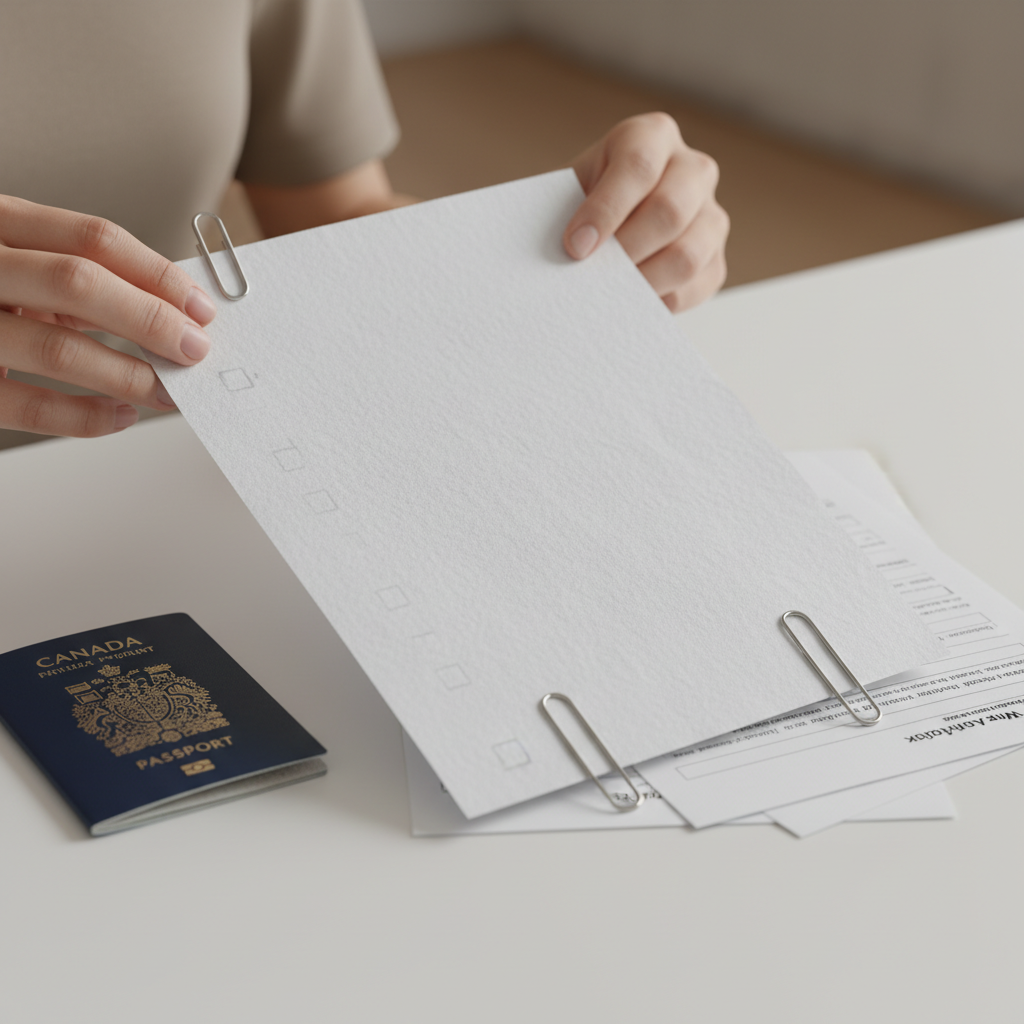
What is a work permit application checklist?
A work permit application checklist is a structured list of required forms, identity documents, proofs of employment and qualifications, and post-submission steps. It prevents omissions that trigger delays or refusals, and adapts to whether you apply inside Canada (IMM 5710) or outside Canada (IMM 1295).
Think of the checklist as your quality-control system. It keeps you aligned with program rules, job classification (NOC/TEER), and timing for biometrics and, when required, immigration medical exams. In our experience, applicants who follow a written checklist complete uploads in one sitting and avoid repeat requests.
- Two core routes: applying from inside Canada versus from abroad.
- Two major permit types: open work permits and employer-specific permits.
- Three common triggers for extra steps: biometrics, medicals, police checks.
Why this checklist matters
Checklists reduce refusals by standardizing documents and timelines. They ensure you present the right form version, accurate work history, and clear scans, which leads to faster processing and fewer IRCC requests for more information.
Missing one item—like a spouse’s enrollment proof for an open work permit—can add weeks. An accurate checklist acts like a pre-flight inspection. We’ve seen well-prepared files move from submission to biometrics letter within days, while incomplete files stall for weeks awaiting clarifications.
- Consistency: File names that mirror your online checklist prevent confusion.
- Compliance: Matching job duties to NOC/TEER signals eligibility.
- Speed: Early biometrics and medical bookings shave days off timelines.
How the work permit process works
The process is: confirm permit type, gather documents, complete the right form (IMM 1295 or IMM 5710), create/enter your IRCC account, upload scans, give biometrics within the deadline, complete medicals if required, submit, then monitor and respond to IRCC messages promptly.
- Pick a permit type: open (e.g., PGWP or spousal) or employer-specific (LMIA or LMIA-exempt under the International Mobility Program).
- Collect identity (passport, photo), status documents, and employment/education proofs.
- Complete IMM 1295 (outside Canada) or IMM 5710 (inside Canada) accurately.
- Set up or log in to your IRCC account; answer background and work history fully.
- Upload readable PDFs/images; use consistent naming (e.g., 01_Passport.pdf).
- Give biometrics within your instruction letter deadline (commonly 30 days).
- Book a panel physician if your role requires a medical exam (healthcare, childcare, etc.).
- Submit and monitor; respond fast to any documentation requests.
For a broader program view, see our Canada work permit overview which explains employer compliance and LMIA-exempt pathways in plain language.
Types of work permits and comparison
Canada issues two main permits: open work permits (no employer listed) and employer-specific permits (tied to one employer, job, and location). The right type depends on your situation—spousal OWP, PGWP, LMIA-based job, or LMIA-exempt category under the International Mobility Program.
| Permit type | Who it’s for | Key proofs | Notes |
|---|---|---|---|
| Open Work Permit | Spouses of students/workers, PGWP graduates, certain policy holders | Status of spouse/student/worker; graduation proof (PGWP); identity | No employer listed; category rules may limit eligible NOC levels |
| Employer-Specific | Direct hires with LMIA or LMIA-exempt job offers | Job offer letter, LMIA or exemption code, employer compliance info | Lists employer, occupation, location, and duration |
| LMIA-Exempt (IMP) | Intra-company transferees, CUSMA professionals, significant benefit | Exemption code, employer portal proof, corporate links | Employer-specific but LMIA-exempt; some streams are faster |
Not sure which lane fits? Our study vs. work permit overview highlights when a study route first makes sense—especially for families planning PR.
The complete work permit application checklist
You need valid ID, the correct IRCC form, job offer/LMIA or exemption proofs, education and work history, resume, ties to home country when relevant, biometrics, and medicals for certain roles. Scan everything clearly, label files, and attach certified translations when documents aren’t in English or French.
Identity & core forms
- Passport valid through your intended work period (aim for 12+ months to avoid early expiry issues).
- Digital photo that meets IRCC specs (proper dimensions and background color).
- IMM 1295 (outside Canada) or IMM 5710 (inside Canada) completed and validated.
- Family Information form and Schedule forms when listed in your personalized checklist.
Employment & qualifications
- Signed job offer with title, duties, and duration (employer-specific only).
- LMIA decision or LMIA-exemption code (e.g., CUSMA/ICT) and employer portal proof.
- Resume/CV, reference letters that mirror job duties, transcripts, and certificates.
- Professional licenses/certifications if your occupation requires them.
Background & admissibility
- Biometrics within the deadline indicated (commonly 30 days after the letter).
- Immigration medical exam if your occupation involves close public contact.
- Police certificates if your IRCC checklist requests them.
Status evidence (inside Canada)
- Copy of current permit or visitor record showing valid status on the day you apply.
- Proof of extension/restoration filing if you need maintained (implied) status.
For related document models (photos, letters, and references), our Express Entry document checklist shows how we structure job duty evidence that aligns with NOC/TEER.
Documents by scenario (14 quick examples)
Document needs vary by scenario. Students shifting to PGWP, spouses seeking an open permit, LMIA hires, and intra-company transferees each submit different proofs. Use these mini checklists to tailor your package and avoid “missing item” delays or procedural fairness letters.
- PGWP graduate: transcript, completion letter, past study permit, validated IMM 5710.
- Spousal OWP (spouse is student): spouse’s study permit, enrollment letter, pay/attendance proof.
- Spousal OWP (spouse is worker): spouse’s work permit, employment letter, recent pay evidence.
- LMIA-based cook: LMIA, detailed job offer, letters matching NOC duties.
- ICT manager: corporate letters proving qualifying relationship, organizational charts.
- CUSMA professional: profession eligibility proof and employer compliance number.
- Global talent: portfolio and evidence of specialized skills/achievements.
- Seasonal agri-worker: program forms and employer compliance docs.
- Caregiver pilot: language scores, relevant experience, job offer.
- Researcher: host institution invitation and role description.
- Co-op student: DLI letter confirming work-integrated learning is mandatory.
- Bridging OWP: PR file number/AOR and ongoing eligibility proof.
- Restoration: timeline evidence and letter of explanation for lapse.
- Visitor to worker: employer-specific offer and updated admissibility evidence.
Planning PR next? Review your options alongside our Express Entry eligibility checklist to keep long-term goals in view.
Local and timing considerations
For Suite 403 Mississauga and the Regional Municipality of Peel, plan biometrics and medicals early, check transit and weather timing, and keep originals accessible. Local scheduling choices can shave days off your timeline when you respond quickly to IRCC requests.
Local considerations for Suite 403 Mississauga
- Transit tip: If you’re traveling for biometrics or medicals, the Hurontario St At Derry Rd and HWY 407 Park and Ride stops simplify connections.
- Seasonal timing: Winter road conditions can add time; book morning slots and keep buffer days for rescheduling.
- Operational nuance: Bring originals to your meeting at 218 Export Blvd; we verify against scans to prevent IRCC re-requests.

Best practices to avoid refusals
Match your duties to NOC/TEER codes, explain any employment gaps, and pair each non-English document with a certified translation. Use file names that mirror your checklist items, and ensure all forms are the latest version before you validate and upload.
- NOC/TEER mapping: Mirror job duty language in references; avoid vague descriptions.
- Explain gaps: Add short, factual letters with proof (study, caregiving, travel).
- Certified translations: Include translator affidavit where required.
- Consistent labeling: 01_Passport.pdf, 02_Photo.jpg, 03_JobOffer.pdf, etc.
- Fresh forms: Re-download forms if your application spans months.
For a plain-language explainer of permit structures and pitfalls, this third-party overview of immigration permit types can help you understand the bigger picture before you file.
Tools and official resources
Use an IRCC online account to complete forms, get messages, and upload documents. Bookmark guidance for biometrics collection and immigration medical exams. If your case is nuanced, an RCIC review helps you catch issues before submission.
- Create and monitor your IRCC account; watch for messages and deadlines.
- Follow guidance on biometrics scheduling and validity windows.
- Review medical exam requirements for your occupation before booking.
- Have an RCIC verify your package when you have complex timelines or prior refusals.
For general legal context on immigration matters, see this immigration law service overview. For career preparation that supports skilled pathways, here’s a practical skills-focused guide many applicants find useful.
Need a second set of eyes? Ask Era Immigration’s RCIC-led team in Mississauga reviews forms, duties vs. NOC/TEER, and translation bundles before you file. One clean submission beats months of back-and-forth. Explore our visitor visa documents guide to see our document-structuring approach in action.
How to choose your permit pathway (buyer’s guide)
Choose your pathway by mapping your goal (work now, study then work, or transition to PR), your status (inside or outside Canada), and your employer’s readiness (LMIA vs. LMIA-exempt). Align documents to that choice before you begin forms to avoid rework.
- If your employer is ready now: Employer-specific permit with LMIA or IMP exemption.
- If you’re graduating: PGWP (open permit) via IMM 5710; align job search to NOC levels.
- If your spouse studies/works: Spousal OWP proof flows from their valid status.
- If long-term PR is the goal: Coordinate with Express Entry eligibility early.
For many families, our study permit checklist plus a spousal OWP is the cleanest sequencing toward PR. The “right” pick is the one that fits your documents today, not in theory.
Process timeline: inside vs. outside Canada
Inside-Canada filings often use IMM 5710 and allow maintained status when you apply before your current status expires. Outside-Canada filings use IMM 1295 and hinge on faster biometrics bookings. In both cases, reply to IRCC messages within the stated window to avoid stalls.
- Inside Canada: Apply before expiry to preserve work authorization where eligible.
- Outside Canada: Book biometrics quickly; upload high-resolution scans at first pass.
- Both: Keep your passport valid long enough to cover the intended work period.
We’ve seen 24–72 hour gaps between submission and biometrics letters on well-prepared files. Poor scan quality and unclear job duties can add weeks through additional document requests.
Document quality standards
High-quality scans and consistent labeling reduce re-requests. Use 300 DPI for documents, avoid glare on photos, and keep file sizes within portal limits. Include certified translations and translator affidavits when documents aren’t in English or French.
- Scan resolution around 300 DPI; export to PDF for multi-page items.
- Use neutral backgrounds and proper dimensions for photos.
- Name files to match your online checklist order (01_, 02_, 03_…).
- Bundle related proofs (e.g., references + contracts) into one logical PDF.
Strong document hygiene is the simplest way to cut 1–2 IRCC follow-up cycles. It also helps if you need to re-use documents later for PR.
After you submit: what to expect
Expect a biometrics instruction letter first, then medical instructions if required, and occasional requests for additional evidence. Monitor your IRCC account daily during the first two weeks; fast responses keep your file moving.
- Biometrics letter within days is common; book immediately.
- Medicals may follow for public-contact roles; choose a panel physician.
- IRCC may request clarifications—reply within the posted deadline.
When your approval arrives, review every line (employer, occupation, location) to ensure the permit matches your job offer. Report any discrepancies at once.
Case examples (Mississauga-focused)
Realistic scenarios help you visualize the checklist. Whether you’re a PGWP graduate, a spouse applying for an open permit, or an LMIA-based hire, tailoring documents to the right stream improves approval odds and shortens processing through fewer follow-ups.
- PGWP grad in Peel: We aligned graduation letters and transcripts, validated IMM 5710, and the file moved without document re-requests.
- Spousal OWP near Derry Rd: We matched the spouse’s NOC to eligibility and attached enrollment/pay stubs for proof of status.
- LMIA chef hire: We synced job duties to NOC, attached LMIA, and added references that mirrored duties verbatim.
If PR is on your horizon, map the work permit step to your long game with our Canada PR process guide.
Frequently Asked Questions
Most applicants ask about permit types, biometrics timing, medical exam triggers, and whether they can apply from inside Canada. These concise answers cover the essentials so you can act confidently and avoid common pitfalls.
Can I apply for a work permit from inside Canada?
Yes, many people can apply to extend or change conditions from inside Canada using IMM 5710 if they have valid status. Your online IRCC checklist will confirm eligibility and list what to upload for your situation.
How soon do I need to give biometrics?
After you submit, IRCC usually issues a biometrics instruction letter with a deadline—commonly 30 days. Book early. Local appointment availability can affect timing, so plan ahead in Mississauga and the broader Peel region.
What triggers a medical exam requirement?
Jobs in healthcare, childcare, eldercare, and roles involving close contact with people often require an immigration medical exam. Your online checklist or an IRCC message will make this clear for your occupation.
What’s the difference between open and employer-specific permits?
An open work permit doesn’t list an employer and allows broader job flexibility. An employer-specific permit ties you to a named employer, occupation, and location, and often relies on an LMIA or an LMIA exemption under the International Mobility Program.
Key takeaways
Choose the right permit type, follow the correct IRCC form, and submit clear, complete proofs. Respond quickly to IRCC requests. When in doubt, get a professional review—one thorough submission is faster than multiple corrections.
- Pick open vs. employer-specific based on your case and documents.
- Use IMM 1295 outside Canada; IMM 5710 inside Canada.
- Plan biometrics/medicals early; keep originals accessible.
- Mirror NOC/TEER duties in references to prevent doubt.
Conclusion
A precise checklist turns a complex work permit into a manageable, trackable project. Prepare forms and proofs, meet deadlines for biometrics/medicals, and monitor your IRCC account. With a local RCIC partner, you’ll catch issues before IRCC does.
Ready to file confidently from Mississauga? Book a review with Ask Era Immigration at 218 Export Blvd, Suite 403. Bring your draft package, and we’ll validate forms, verify NOC alignment, and confirm your scenario-specific documents—so you can submit once, and submit right.
